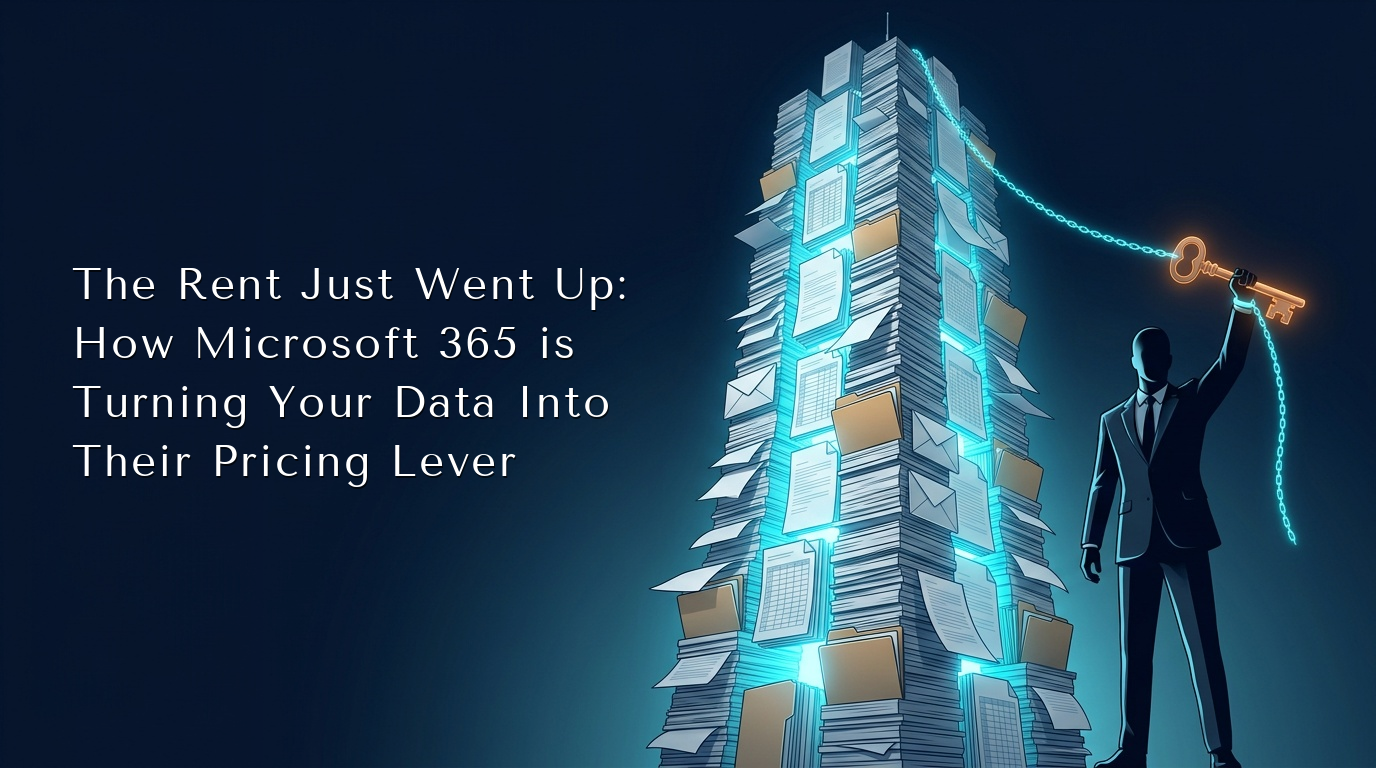
The Rent Just Went Up: How Microsoft 365 is Turning Your Data Into Their Pricing Lever
If you renewed a Microsoft 365 subscription after July 1, 2026, you already know: prices went up 5–33% across every plan. Office 365 E3 jumped 13% (from $23 to $26 per user/month), Business Basic climbed 17%, and enterprise tiers now bundle AI features — whether you asked for them or not (Microsoft Licensing , Sourcepass ).
Here’s pattern worth naming: Microsoft isn't just selling software anymore. It's selling access to your own data back to you indexed, summarized, and "copiloted" through an AI layer that sits between you and everything your company has ever written, emailed, or spreadsheeted. Lock-in is architectural, not contractual.
Copilot works because it can crawl across SharePoint, Teams, Outlook, and OneDrive simultaneously. Every document your organization creates inside M365 makes Microsoft's AI smarter and your exit more expensive. You are not renting tools anymore; you are compounding someone else's asset, and the security math is ugly.
Researchers have found that roughly 16% of business-critical data inside M365 tenants is overshared — an average of 802,000 exposed files per organization — and Copilot surfaces all of it to anyone who asks the right question (Concentric AI, Cambium Data ).
The AI conversation nobody is having honestly
Every enterprise is moving towards "deploying AI" — and most vendors mean their AI, on their cloud, billed per seat.
But 2026's project postmortems keep landing on the same conclusion: most enterprise AI failures are data problems, not model problems. AI fails quietly on inconsistent attributes, duplicate SKUs, and identifiers that do not match physical reality. Garbage in, confidently-wrong out but at scale and with a friendly chat interface on top (IBM , Argos ).
The honest sequence:
1. Own your data before renting intelligence on top of it. Whoever owns the established record controls the pricing lever, forever.
2. Fix the foundation first. AI amplifies existing data quality; it does not repair it.
3. Deploy against standards, not silos. An AI agent is only as trustworthy as the identifiers it reasons over.
The price increase, the bundling, the copilot that cannot be cleanly disabled… none of it is a coincidence. It is a landlord raising rent on a building you created.
The only durable counter-move is keeping your organization's core truth, especially your product truth, in infrastructure you control, governed by open standards rather than a vendor's index.

Satellites: The Future of Data Redundancy - Why the Ground Is No Longer Enough

For decades, data redundancy meant one thing… more servers… in more buildings… in more cities. Enterprises replicated their workloads across terrestrial data centers, trusting fiber optic cables and regional cloud zones to keep the bits flowing. But as our digital dependencies deepen and as climate events, cyberattacks, and geopolitical instability intensify the on-earth model is showing its cracks. The next layer of resilience isn't underground or across an ocean. It's overhead.
Satellites, once the exclusive domain of governments and telecom giants, are rapidly emerging as a critical tier in enterprise data redundancy strategy. With the explosion of low-Earth-orbit (LEO) constellations, plummeting launch costs, and edge computing moving into space itself, we are witnessing the birth of a genuinely off-planet backup layer.
The Problem with Purely Terrestrial Redundancy
Traditional disaster recovery playbooks recommend the 3-2-1 rule: three copies of your data, on two different media, with one copy offsite. That "offsite" copy has historically meant another data center in another region.
But consider what happens when:
• A regional cloud outage cascades across multiple availability zones (as has happened repeatedly with major hyperscalers)
• Undersea cables are cut, accidentally by anchors or deliberately by state actors, severing entire countries from the global internet
• A natural disaster (wildfire, hurricane, earthquake, flood) simultaneously affects primary and secondary sites within the same geographic risk zone
• Ransomware encrypts backups that are still network-reachable, no matter how geographically distant
Each of these scenarios exposes the same underlying vulnerability: terrestrial redundancy still shares a physical substrate — the Earth's surface and the infrastructure crawling across it.
True redundancy requires a fundamentally different medium.
Why Satellites Change the Equation
1. A Physically Independent Layer
A copy of your data orbiting 550 kilometers above the planet is, by definition, isolated from ground-based failure modes. Fiber cuts, power grid failures, regional flooding, and building fires simply cannot reach it. Satellite storage introduces physical diversity to redundancy planning in a way no second data center ever can.
2. LEO Constellations Have Rewritten the Economics
The reason satellite data services are viable today (and not a decade ago) is the dramatic collapse in cost-per-kilogram to orbit. Constellations like Starlink, OneWeb, Amazon's Project Kuiper, and China's Guowang are pushing thousands of satellites into low Earth orbit, providing:
• Low latency (20–40 ms round trip, competitive with terrestrial broadband)
• High throughput (hundreds of Mbps to Gbps per user terminal)
• Global coverage, including over oceans, poles, and conflict zones
What used to be a niche geostationary service priced for governments is now approaching commodity broadband and the same rails can carry backup traffic.
3. Space-Based Storage and Compute Are Real
Beyond simply transmitting data through space, a growing category of companies is putting actual storage and compute payloads in orbit. Ventures like Lonestar Data Holdings (lunar data centers), Axiom Space, and various defense-adjacent startups are demonstrating that a satellite isn't just a relay; it can be a resilient node in a distributed storage network. Data written to orbit is exposed to a completely different threat model than data on Earth: no local floods, no insider physical access, no municipal power outages.
4. Air-Gapped by Default
Space-based archives can be architected with intermittent, tightly controlled uplink windows. This creates a natural air gap which is one of the most effective defenses against ransomware. Attackers cannot encrypt what they cannot reach, and orbital nodes can be configured to accept writes only during specific authenticated windows, making them a modern equivalent of a vault.
Practical Use Cases Emerging Today
Financial institutions are exploring satellite backup for critical transaction ledgers, ensuring that even a nationwide disruption of terrestrial networks would not compromise the ability to reconstruct the day's book.
Governments and defense agencies are treating orbital storage as a sovereignty tool. Data that cannot be seized, subpoenaed, or physically raided because it isn't in any jurisdiction on the ground.
Media and archival organizations are using satellite links to replicate irreplaceable cultural artifacts, treating orbital storage as a "digital Svalbard" analogous to the seed vault.
Remote industries like offshore rigs, polar research stations, maritime shipping, and remote mining are using LEO satellite links not just for connectivity but for continuous, resilient backup that doesn't depend on ever reaching a terrestrial POP.
Cloud providers themselves are quietly building satellite egress and ingress as part of their disaster recovery offerings, letting customers replicate to space as a regionless target.
The Architecture of the Future: A Multi-Tier Redundancy Model
The redundancy stack of the near future will likely look something like this:
• Tier 1 — Primary data on hot storage in a regional cloud
• Tier 2 — Warm replica in a geographically distant region
• Tier 3 — Cold backup in a different cloud provider or on-prem tape
• Tier 4 — Orbital archive: an immutable, air-gapped copy in space, unreachable by terrestrial threats and independent of Earth-bound infrastructure
That fourth tier used to be theoretical. Today, it is being provisioned by paying customers.
Challenges Worth Acknowledging
None of this is without friction. Satellite bandwidth, while improving, is still measured in megabits rather than the terabits an enterprise might move between on-Earth regions. Latency to geostationary storage is high, though LEO closes much of that gap. Radiation hardening of storage media in orbit is an active engineering challenge, and space debris and Kessler syndrome risks cast a long shadow over the whole industry. Regulatory questions about jurisdiction over orbital data are barely settled.
But every one of these is a solvable engineering or policy problem and not a fundamental barrier. And each generation of launch vehicles, satellite bus, and inter-satellite laser link narrows the gap further.
The Broader Shift
What's really happening is bigger than backup. Satellites are becoming a peer tier of the internet's infrastructure, not an exotic alternative to it.
The moment orbital storage becomes as easy to provision as an S3 bucket. The same API call, the same billing model, just a different physical location. Enterprise architects will treat space the way they now treat multi-region: as a checkbox, not a project.
Data redundancy has always been, at heart, a story about geography. First it was another room. Then another building. Then another city, another continent, another cloud. The next step in that lineage isn't horizontal. It's vertical. Straight up.l

When a Barcode Becomes a Legal Asset: Why Modern Corporate Counsel Must Understand Data, Systems, and Scale
Most people think of a barcode as a simple operational tool.
In reality, it is often the visible front end of something far more valuable: a trusted data standard that allows manufacturers, retailers, healthcare providers, logistics teams, and consumers to operate from the same source of truth.
When that shared language works, commerce moves efficiently. When it breaks down, costs rise quickly through disputes, delays, inventory issues, recalls, inconsistent records, and preventable friction. That is why organizations focused on standards and trusted data occupy an increasingly strategic position in the modern economy.
It is also why the role of corporate counsel inside those organizations is evolving.
Today’s in-house legal teams are not limited to reviewing contracts after business decisions have already been executed. The strongest counsel teams help shape scalable systems in advance, creating frameworks that support growth, innovation, and trust.
That can include advising on:
Commercial contracting and revenue partnerships
SaaS, cloud, and enterprise vendor agreements
Data governance and permissible use of structured data
Privacy and security risk allocation
Intellectual property strategy
Emerging AI use cases involving enterprise datasets
Cross-functional operational processes that reduce friction
Increasingly, effective counsel must also understand the realities of implementation.
Legal obligations do not live only in contract language. They live in systems, workflows, permissions, integrations, retention schedules, vendor relationships, and day-to-day business execution.
That is where legal technology awareness becomes a meaningful advantage.
Counsel who understand how data moves through organizations can often identify risk earlier, communicate more clearly with technical stakeholders, and help build practical solutions that business teams can actually use. This becomes even more important as industries adopt RFID, 2D barcodes, traceability tools, and more intelligent supply-chain ecosystems.
In sectors such as food and healthcare, trusted data is not merely efficient—it can directly affect safety, responsiveness, and public confidence.
The future will belong to organizations that combine standards, technology, and trust at scale. And the legal teams supporting them may just determine how quickly that future arrives.

Where Healthcare Contracts Quietly Lose Money (And How to Catch It)
Most cost issues in healthcare contracts aren’t obvious. They don’t show up as line items but are rather hidden in the assumptions no one questions.
And by the time they’re visible, the money is already gone.
1. The “Default Renewal” Trap
Contracts roll over. Pricing doesn’t get questioned. Vendors rely on this behavior, similar to how cell phone subscription apps auto-renew without scrutiny.
What to watch for:
Auto-renewals with built-in increases
“Standard” pricing language that was never benchmarked
Legacy rates carried into new scopes
Shift in mindset:
Every renewal is a renegotiation, even if no one says it out loud. (I would.)
2. The “Bundled Services” Illusion
Bundling feels efficient but rarely is.
When services are grouped together, visibility disappears. And when visibility disappears, so does accountability.
What to watch for:
Flat-rate bundles with no usage breakdown
Services that can’t be measured individually
“All-in” pricing that prevents comparison
Shift in mindset:
If you can’t separate it, you can’t evaluate it. The devil is in the details and without visibility into spend, you can’t effectively manage margin. You wouldn’t accept a bundled utilities bill without knowing what portion is water, electricity, and so on. Without that breakdown, your ability to control costs disappears.
3. The “We’ve Always Used Them” Premium
Familiar vendors are comfortable; relationships replace scrutiny and pricing drifts.
What to watch for:
No recent competitive bids
Long-term vendors without performance benchmarks
Resistance to exploring alternatives
Shift in mindset:
Loyalty, transparency and trust should be earned continuously rather than be treated as assumed.
4. The “Scope Creep Without Pricing Creep” Myth
Scope always moves, and pricing is the growing shadow following along,
New data sources, expanded users, additional workflows, all layered in without clear, dependable reporting and cost recalibration.
What to watch for:
Undefined or flexible scope language
Add-ons that aren’t clearly priced
“Support” or “enhancements” without boundaries
Shift in mindset:
If scope expands, pricing should be re-evaluated…every.single.time.
Final Thought
One of the most predictable pricing risks isn’t a bad vendor; it’s a passive process. How you question the fine print determines how well you can manage services later. Once you start questioning, the gaps become more clear.
Contract analysts are uniquely positioned, not just to review agreements, but to challenge assumptions, create visibility, bring intention to cost, and translate risk across both technology and financial impact. It’s work that extends beyond contracts and actually shapes decisions that ultimately affect every day patient care and outcomes.
If you're building teams that think more intentionally about pricing (real and future), you're not just saving money…you’re creating leverage and reclaiming your position price negotiations.

Why Healthcare Contracts Fail After Signature (And How to Prevent It)
In healthcare, contracts are often treated as the finish line.
They’re not. They’re the starting point.
Most organizations invest significant time negotiating terms related to pricing, timelines, data access and compliance requirements…only to see those same agreements quietly break down once they move into operations.
Not because anyone acted in bad faith.
But because the contract and the systems it depends on were never truly aligned.
The Illusion of Completion
A contract gets signed. Everyone moves on.
Legal assumes risk has been addressed
Procurement assumes the vendor is approved
IT assumes requirements are feasible
Operations assumes everything will just… work
But these assumptions rarely match reality.
A contract might require “real-time data access,” while the underlying systems update every 30 minutes (APIs can also have rate-limiting).
A vendor may be marked “approved” in one system while still pending security review in another.
An SLA may exist on paper but never be tracked anywhere operationally.
At that point, the contract isn’t wrong—it’s just disconnected.
Where Things Actually Break
In my experience, failures tend to fall into three patterns:
1. System Disconnects
Different teams operate in different systems that don’t fully align. Legal, procurement, and IT may each have their own version of the truth.
2. Invisible Obligations
Key terms—SLAs, renewal conditions, performance requirements—exist in the contract but are never captured in a system that can track them.
3. Assumed Feasibility
Contracts are finalized without validating whether the technology can actually support what’s being promised.
Why This Matters More Than Ever
This challenge becomes even more pronounced during major system transitions—like healthcare organizations moving from legacy platforms to modern ecosystems.
Take an EHR migration, for example.
To an end user, it may look like a new interface.
Operationally, it’s a complete reconfiguration of:
Data flows
Vendor integrations
Access controls
Reporting structures
Contracts written for one environment don’t always translate cleanly into another.
And if that gap isn’t addressed early, it shows up later—in delays, rework, or risk.
A Better Approach: Contracts as Operational Tools
The role of a strong contract function isn’t just to negotiate terms—it’s to ensure those terms can live and function in the real world.
That means asking different questions early:
Where will this data actually live?
How will this obligation be tracked?
Do our systems support what we’re agreeing to?
Who is responsible for maintaining this over time?
When contracts are treated as operational tools—not just legal documents—they become far more effective.
The Shift
The most effective organizations aren’t the ones with the most detailed contracts.
They’re the ones where:
Legal, IT, and operations stay aligned
Systems reflect what’s written
And someone is thinking about what happens after the signature
Because that’s where the real work begins.
At Delphoria, we believe contracts shouldn’t just define agreements—they should work seamlessly within the systems and teams that rely on them.
That’s where clarity becomes execution.
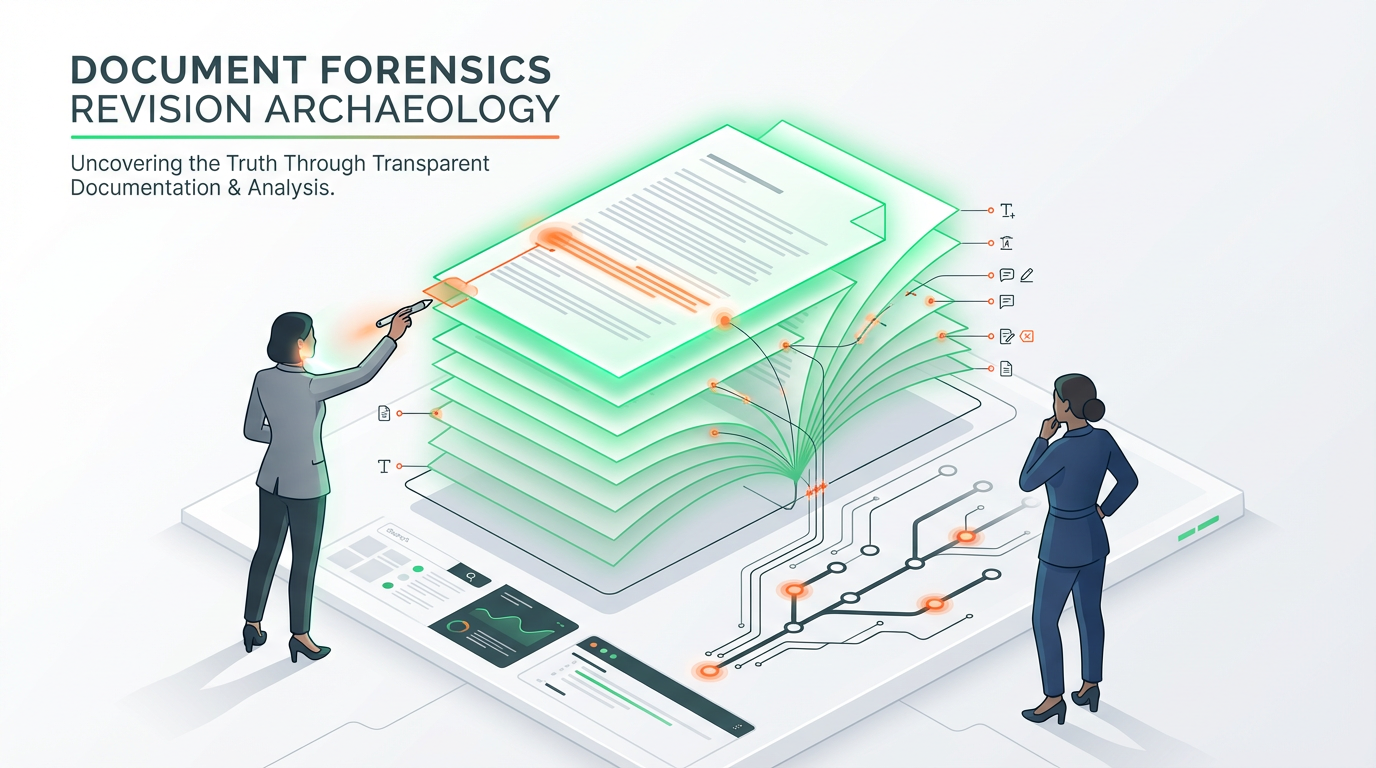
Collaborative Documents as Evidence: What Version History Can Reveal in Digital Investigations
Collaborative platforms quietly record detailed histories of how documents evolve. For investigators and legal teams, those revision logs can reveal timelines, authorship, and intent that traditional files were never designed to capture.
Collaborative documents have fundamentally changed how organizations create information. Instead of sending files back and forth through email, teams now work inside shared platforms where multiple people can edit the same document in real time.
While this shift improves productivity, it also creates a new and often overlooked source of investigative evidence: document version history.
For investigators, auditors, and litigation teams, these revision logs can provide insight into how information evolved over time.
The Hidden Record Inside Collaborative Platforms
Modern collaboration platforms such as Google Docs and Microsoft 365 maintain detailed logs of document activity.
These logs may include:
• who edited the document
• when edits occurred
• what content was added or removed
• previous versions of the document
• comment history and suggestions
Unlike traditional documents, collaborative files often preserve a complete timeline of changes, allowing investigators to reconstruct how a document developed.
Why Version History Matters in Investigations
In many investigations, the key question is not simply what a document says today, but how it reached its current state.
Version history can help answer questions such as:
• Who originally created the document?
• When was sensitive language introduced or removed?
• Were edits made after a key event occurred?
• Did multiple individuals collaborate on a specific section?
This type of analysis can reveal patterns of decision-making, coordination, or intent that would otherwise remain hidden.
Metadata Beyond the File
Traditional files often contain limited metadata, such as creation dates or last-modified timestamps.
Collaborative platforms go much further.
Many systems record:
• granular edit timestamps
• user identity tied to enterprise authentication
• suggestion and approval workflows
• comment threads and discussion context
Together, these elements can create a detailed picture of how information moved through an organization.
Challenges for Forensic Collection
Despite their value, collaborative documents can be difficult to collect in forensic investigations.
Unlike static files stored on a hard drive, cloud documents often exist primarily as database objects within a platform. Exporting them may flatten the document into a single file, potentially losing important version history.
As a result, investigators must carefully consider:
• how data is exported from collaboration platforms
• whether version histories are preserved during collection
• what APIs or administrative tools are used for data extraction
Failing to account for these issues can result in losing critical contextual information.
A New Category of Evidence
As collaboration tools continue to replace traditional file workflows, investigators will increasingly encounter evidence that exists primarily in dynamic, cloud-based systems.
Understanding how collaborative documents function—and how their histories are recorded—will become an essential skill for legal technology professionals, forensic investigators, and litigation teams.
In many cases, the most revealing evidence may not be the document itself, but the story told by its revisions.
Could Blockchain Solve the Version Control Problem for Collaborative Documents?
Digital collaboration has transformed how legal teams work, but version control still creates uncertainty. Could blockchain provide a tamper-evident way to track document history and verify authenticity in collaborative environments?
Modern work lives inside collaborative documents. Contracts, investigative reports, internal memos, discovery productions, and research notes are all created by multiple people editing the same files across time.
Tools like Google Docs and Microsoft 365 have made collaboration easier than ever. But underneath that convenience sits a quiet problem: version control still breaks down surprisingly often.
Anyone who has worked on a complex document has seen it happen.
“Final.docx”
“Final_v3.docx”
“FINAL_REAL_THIS_ONE.docx”
When documents travel outside their original system—downloaded, emailed, or copied—the history of who changed what can quickly become unclear. In everyday work that might just be annoying. In legal, forensic, or compliance contexts, it can become a serious issue.
But what if documents behaved less like files and more like ledgers?
The Version Control Problem
Most collaborative platforms maintain a revision history for documents. These systems record edits, timestamps, and sometimes the identity of the person who made the change.
However, those histories exist inside centralized systems.
That introduces several limitations:
• The platform owner controls the revision record
• Administrative access can alter system logs
• Copies of documents outside the system lose their version history
• Verification of document integrity depends on trusting the platform
For many workflows this is perfectly acceptable. But for high-stakes environments—litigation, regulatory investigations, forensic analysis—document history can become evidence.
In those scenarios, trust in the revision record becomes just as important as the document itself.
Enter Blockchain
Blockchain technology operates on a fundamentally different model.
Instead of storing information in a single database controlled by one organization, blockchain systems record transactions across a distributed ledger. Each record is cryptographically linked to the previous one, forming a chain of blocks that cannot easily be altered without detection.
In simple terms:
Every entry becomes permanent.
Every change becomes traceable.
Applied to collaborative documents, the idea becomes powerful.
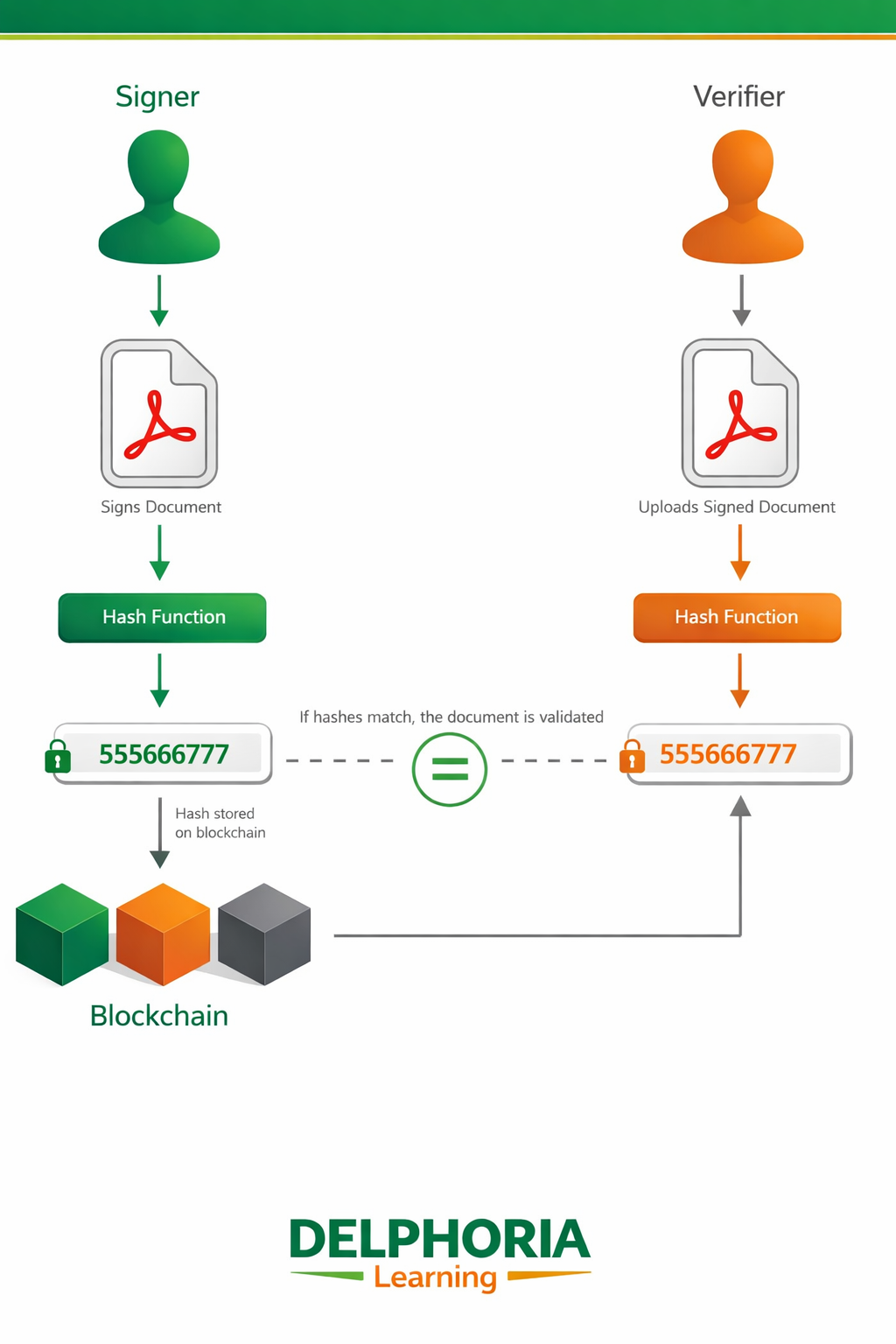
Instead of storing revision history only inside a platform, each version of a document could be cryptographically recorded on a blockchain ledger.
How Blockchain Version Control Would Work
Imagine a document lifecycle that works like this:
A document is created.
A cryptographic fingerprint (called a hash) of the document is generated.
That hash is recorded on a blockchain ledger with a timestamp.
Each time the document is edited, a new hash is generated.
The new hash is linked to the previous one.
This creates a permanent chain of document states.
If someone later wants to verify a document's authenticity, they simply generate its hash and compare it to the blockchain record. If the hashes match, the document is proven to be identical to the recorded version.
In effect, the blockchain becomes a tamper-evident timeline of the document’s evolution.
Why This Matters for Legal and Forensic Workflows
For legal technology professionals, the implications are significant.
Blockchain-anchored document histories could provide:
Immutable audit trails
Every version of a document is permanently recorded.Proof of authorship
Edits can be cryptographically linked to verified identities.Integrity verification
A document can be proven unchanged since a specific point in time.Chain of custody support
The document’s lifecycle becomes mathematically verifiable.
For digital forensics practitioners, this begins to resemble evidence handling procedures applied directly to collaborative documents.
Instead of reconstructing document history after the fact, the history would already be preserved in a trusted ledger.
Practical Limitations
Despite the promise, blockchain is not a perfect solution for document collaboration.
Several challenges remain:
Storage efficiency
Blockchains are not ideal for storing large files. Most systems would store document hashes rather than the files themselvesPrivacy concerns
Public blockchains expose metadata that may not be appropriate for sensitive legal or corporate information.Performance
High-frequency editing could create massive numbers of transactions.User experience
Most professionals do not want to interact with cryptographic wallets just to edit a document.
Because of these limitations, the most realistic implementation would likely be a hybrid model.
Documents remain stored in traditional cloud systems, while blockchain records serve as independent verification of document integrity and revision history.
The Bigger Idea
The deeper shift here is conceptual.
Today, documents are simply files stored on systems.
But in a blockchain-enabled future, documents could become verifiable digital objects that carry their own proof of authenticity and history.
Every change would leave a trace.
Every version could be proven.
For industries built on trust—law, finance, investigations, and compliance—that kind of transparency could fundamentally change how collaborative information is preserved and verified.
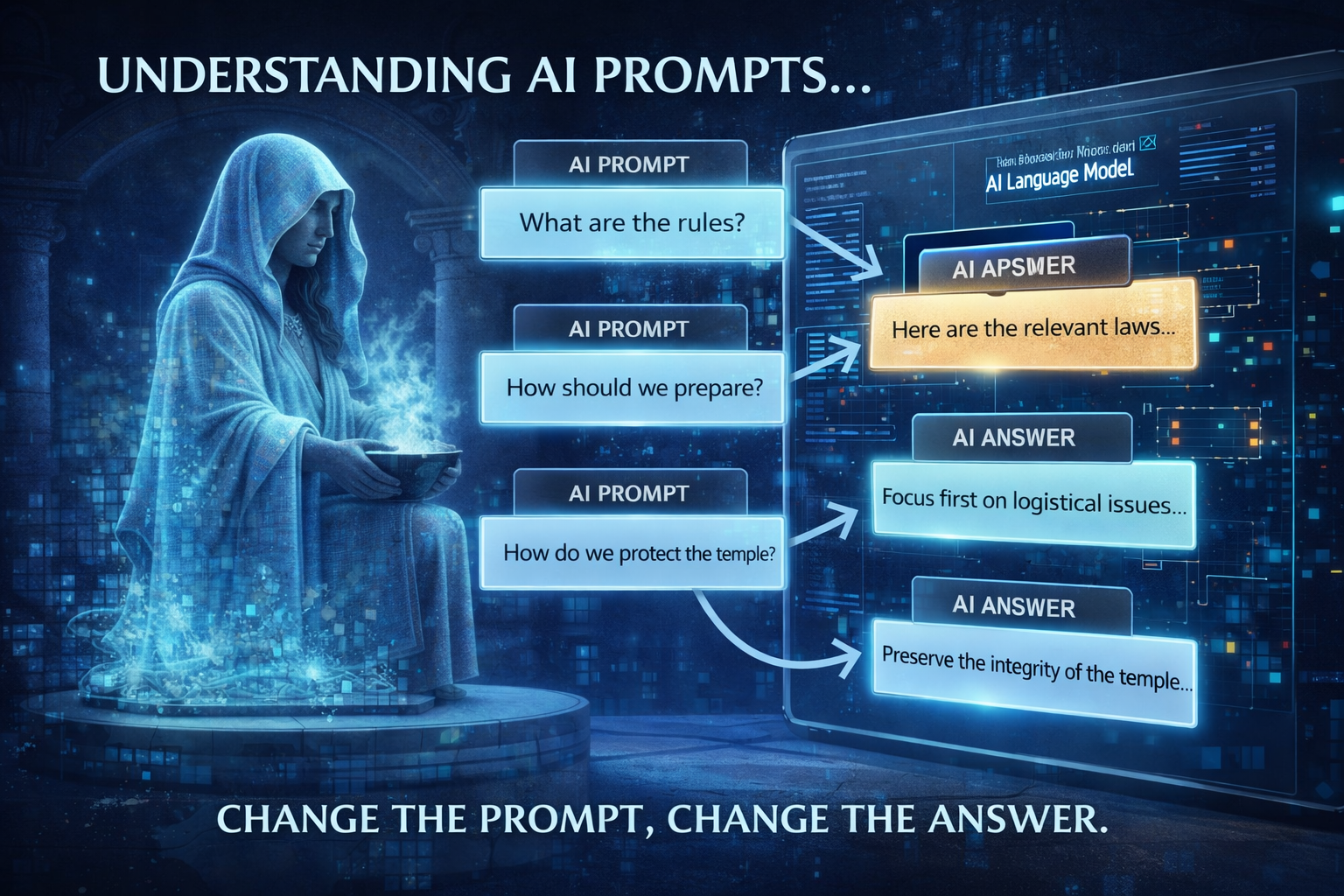
Why AI Answers Change When You Ask the Same Question Differently
Small changes in wording can produce very different AI responses. Understanding why helps lawyers use AI tools more thoughtfully and evaluate their outputs more effectively.
How language models interpret prompts — and why the framing of a question often shapes the answer.
Many lawyers experimenting with artificial intelligence notice something strange:
Ask the same question twice with slightly different wording, and the answer can change.
At first glance this can make the technology seem unreliable. In reality, it reflects how large language models actually work.
Understanding why this happens can help lawyers use these tools more effectively and evaluate their outputs more thoughtfully.
AI Does Not Read Language the Way Humans Do
When humans read a sentence, we interpret meaning as a whole.
Large language models process language differently. Before analyzing a prompt, the system breaks the text into small pieces called tokens. These tokens may represent words, parts of words, or punctuation.
The model then evaluates patterns between those tokens based on relationships learned during training.
In other words, the system is not “understanding” language the way a human does. It is identifying statistical patterns between pieces of text.
Small Changes in Wording Can Shift Context
Because the model works by identifying patterns, subtle changes in phrasing can influence the context it detects.
Consider these questions:
• What are the Department of Justice rules on producing text messages?
• What DOJ guidance exists regarding preservation of text messages in litigation?
• What federal rules apply to producing text messages?
To a human reader, these questions appear very similar. But to a language model, they activate slightly different contexts.
The first question suggests agency policy.
The second implies litigation guidance.
The third invites discussion of procedural rules.
Each framing leads the model toward different information.
Why Precision Matters
Lawyers already understand that the framing of a question affects the answer. The same principle applies when interacting with AI systems.
Clear prompts that identify the relevant authority, context, and objective tend to produce more useful responses.
For example, compare:
“What are the DOJ rules on producing text messages?”
with
“What guidance has the U.S. Department of Justice issued regarding preservation and production of text messages in litigation?”
The second prompt provides a clearer framework for the system to interpret.
AI Is a Tool, Not an Authority
None of this means AI tools are unreliable. It simply means their outputs depend heavily on how questions are framed.
Used thoughtfully, these systems can be powerful research assistants.
But like any tool in legal practice, they work best when the user understands how they operate.
And often, the quality of the answer begins with the quality of the question.
¹ Footnotes from Pythia is the Delphoria Learning series exploring artificial intelligence, legal technology, and the systems shaping modern legal practice.

Collaborative Documents and the Metadata Maze
Modern organizations live in shared documents — Google Docs, Microsoft 365, Box Notes — where multiple hands can alter a file in seconds. While this real-time collaboration boosts productivity, it complicates one of eDiscovery’s most fundamental requirements: collecting and preserving metadata.
Metadata — authorship, timestamps, version history, permissions, and more — tells the story of a document’s creation and evolution. Yet exporting this data intact often becomes a technical and policy bottleneck.
Key challenges include:
Loss of context upon export: When a collaborative document is converted into static formats (like PDF or DOCX), dynamic metadata such as comment threads, version history, and edit authorship may be stripped away or flattened. What’s left rarely meets evidentiary standards.
Platform-specific limitations: Each cloud provider structures metadata differently. For instance, Google Workspace’s activity logs differ vastly from Microsoft’s audit trails, forcing discovery teams to normalize dissimilar outputs.
Encrypted or private files: Search term collection becomes particularly complex when user-level encryption or enterprise privacy settings block indexers. Even with proper authorization, accessing or decrypting files for keyword processing can present both technical and legal risks.
Organizations can mitigate these issues by implementing collection policies tailored to each platform. Capture source metadata early, configure export settings for forensic completeness, and maintain a record of system limitations. When encryption or granular permissions are in play, proactive collaboration with IT and information security teams ensures compliance without breaking privacy protocols.
Example: During an internal investigation, a firm discovered critical user edits tucked within Google Docs version history—data never visible in the exported version. Adjusting their collection procedure to leverage the API rather than manual downloads preserved the complete context.
The takeaway: in a collaborative environment, the document is no longer just the file—it’s the ecosystem around it.
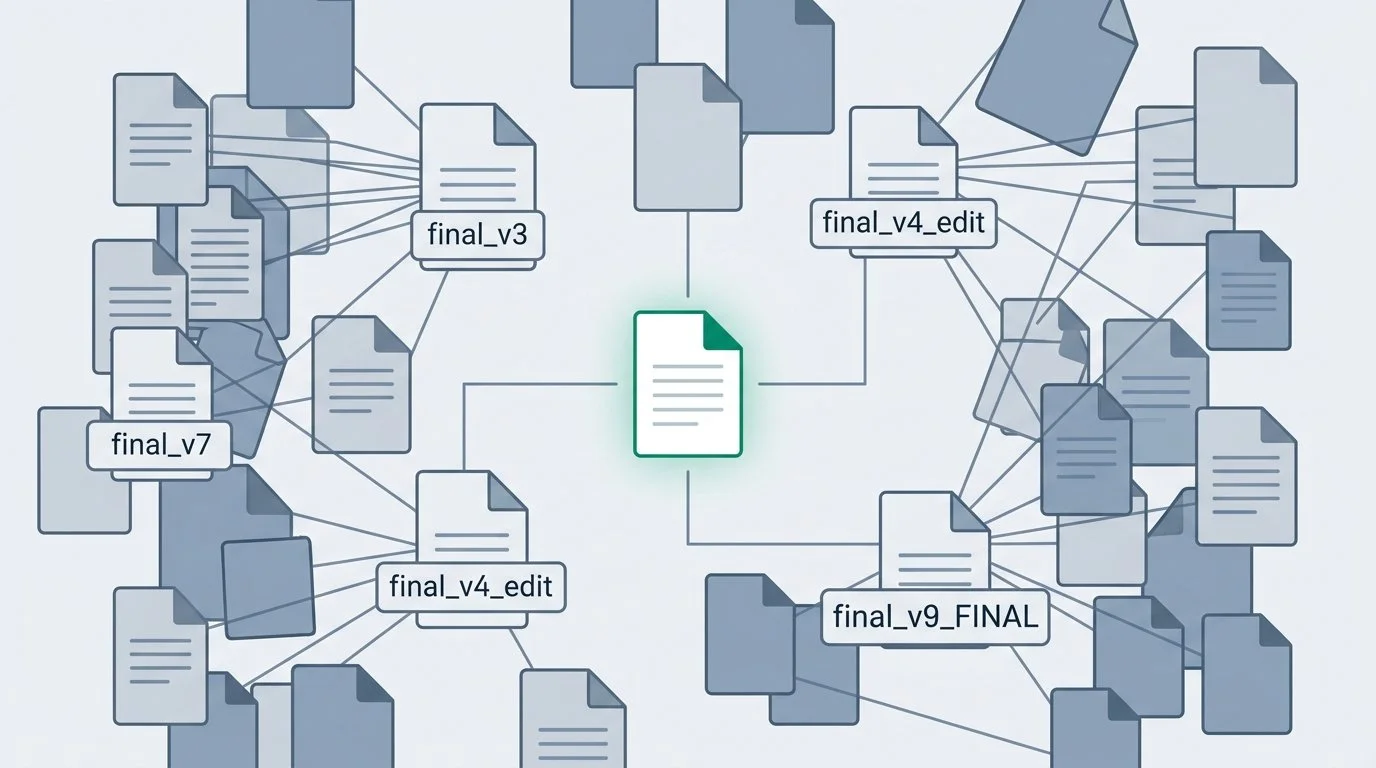
Version Sprawl
In digital workspaces, version sprawl has quietly become one of the biggest drains on eDiscovery efficiency. From drafts labeled “final_v7_REAL_FINAL” to thousands of slight alterations synced through SharePoint or Teams, organizations struggle to determine which version truly matters.
This proliferation has both operational and legal consequences:
Storage bloat: Repeated saves and syncs inflate repositories, driving up storage costs and making later collection cumbersome.
Review confusion: Review teams waste time sifting through near-duplicates, with inconsistent metadata further complicating deduplication strategies.
Missed evidence: When custodians download files and re-upload them from personal devices, version lineage breaks — leaving gaps in the document’s story.
The solution lies in strong version governance. Clear naming conventions, access controls, and retention cutoffs can reduce the chaos. Modern document management systems offer version control settings and deduplication functions that help map a clean lineage of each file. Automated workflows to archive or merge redundant versions can further streamline the process.
Incorporating version-tracking metadata into an eDiscovery platform also improves defensibility. A clearly auditable chain of custody — which file was updated, by whom, and when — strengthens your production narrative.
Illustration: A case team handling a 365-terabyte collection used automated version recognition to consolidate 15,000 file variants into 1,200 unique documents — cutting review volume by over 90%.
Version sprawl may start as a nuisance but ends as a governance crisis. Managing it early is the difference between chaos and clarity in your data universe.