Satellites: The Future of Data Redundancy - Why the Ground Is No Longer Enough
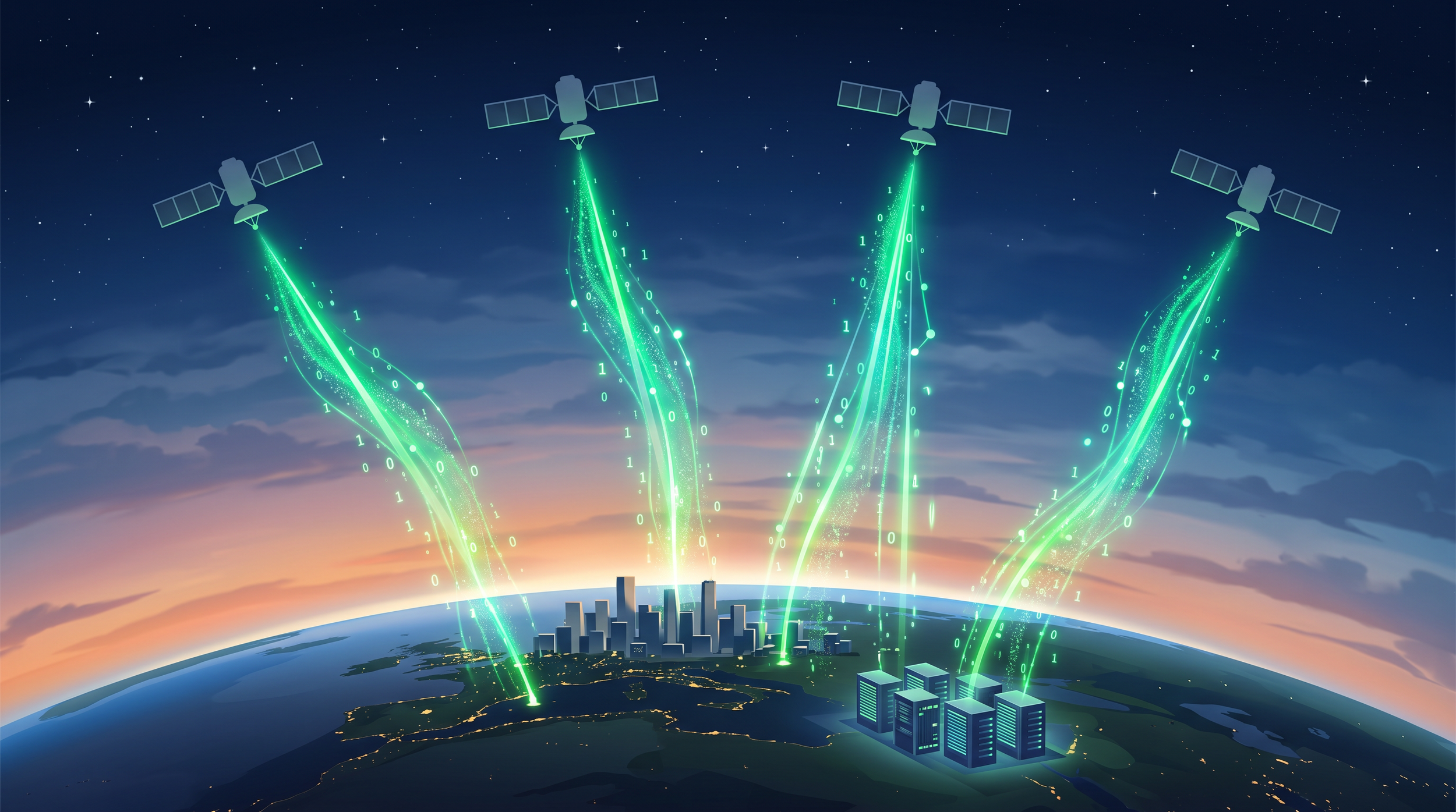
For decades, data redundancy meant one thing… more servers… in more buildings… in more cities. Enterprises replicated their workloads across terrestrial data centers, trusting fiber optic cables and regional cloud zones to keep the bits flowing. But as our digital dependencies deepen and as climate events, cyberattacks, and geopolitical instability intensify the on-earth model is showing its cracks. The next layer of resilience isn't underground or across an ocean. It's overhead.
Satellites, once the exclusive domain of governments and telecom giants, are rapidly emerging as a critical tier in enterprise data redundancy strategy. With the explosion of low-Earth-orbit (LEO) constellations, plummeting launch costs, and edge computing moving into space itself, we are witnessing the birth of a genuinely off-planet backup layer.
The Problem with Purely Terrestrial Redundancy
Traditional disaster recovery playbooks recommend the 3-2-1 rule: three copies of your data, on two different media, with one copy offsite. That "offsite" copy has historically meant another data center in another region.
But consider what happens when:
• A regional cloud outage cascades across multiple availability zones (as has happened repeatedly with major hyperscalers)
• Undersea cables are cut, accidentally by anchors or deliberately by state actors, severing entire countries from the global internet
• A natural disaster (wildfire, hurricane, earthquake, flood) simultaneously affects primary and secondary sites within the same geographic risk zone
• Ransomware encrypts backups that are still network-reachable, no matter how geographically distant
Each of these scenarios exposes the same underlying vulnerability: terrestrial redundancy still shares a physical substrate — the Earth's surface and the infrastructure crawling across it.
True redundancy requires a fundamentally different medium.
Why Satellites Change the Equation
1. A Physically Independent Layer
A copy of your data orbiting 550 kilometers above the planet is, by definition, isolated from ground-based failure modes. Fiber cuts, power grid failures, regional flooding, and building fires simply cannot reach it. Satellite storage introduces physical diversity to redundancy planning in a way no second data center ever can.
2. LEO Constellations Have Rewritten the Economics
The reason satellite data services are viable today (and not a decade ago) is the dramatic collapse in cost-per-kilogram to orbit. Constellations like Starlink, OneWeb, Amazon's Project Kuiper, and China's Guowang are pushing thousands of satellites into low Earth orbit, providing:
• Low latency (20–40 ms round trip, competitive with terrestrial broadband)
• High throughput (hundreds of Mbps to Gbps per user terminal)
• Global coverage, including over oceans, poles, and conflict zones
What used to be a niche geostationary service priced for governments is now approaching commodity broadband and the same rails can carry backup traffic.
3. Space-Based Storage and Compute Are Real
Beyond simply transmitting data through space, a growing category of companies is putting actual storage and compute payloads in orbit. Ventures like Lonestar Data Holdings (lunar data centers), Axiom Space, and various defense-adjacent startups are demonstrating that a satellite isn't just a relay; it can be a resilient node in a distributed storage network. Data written to orbit is exposed to a completely different threat model than data on Earth: no local floods, no insider physical access, no municipal power outages.
4. Air-Gapped by Default
Space-based archives can be architected with intermittent, tightly controlled uplink windows. This creates a natural air gap which is one of the most effective defenses against ransomware. Attackers cannot encrypt what they cannot reach, and orbital nodes can be configured to accept writes only during specific authenticated windows, making them a modern equivalent of a vault.
Practical Use Cases Emerging Today
Financial institutions are exploring satellite backup for critical transaction ledgers, ensuring that even a nationwide disruption of terrestrial networks would not compromise the ability to reconstruct the day's book.
Governments and defense agencies are treating orbital storage as a sovereignty tool. Data that cannot be seized, subpoenaed, or physically raided because it isn't in any jurisdiction on the ground.
Media and archival organizations are using satellite links to replicate irreplaceable cultural artifacts, treating orbital storage as a "digital Svalbard" analogous to the seed vault.
Remote industries like offshore rigs, polar research stations, maritime shipping, and remote mining are using LEO satellite links not just for connectivity but for continuous, resilient backup that doesn't depend on ever reaching a terrestrial POP.
Cloud providers themselves are quietly building satellite egress and ingress as part of their disaster recovery offerings, letting customers replicate to space as a regionless target.
The Architecture of the Future: A Multi-Tier Redundancy Model
The redundancy stack of the near future will likely look something like this:
• Tier 1 — Primary data on hot storage in a regional cloud
• Tier 2 — Warm replica in a geographically distant region
• Tier 3 — Cold backup in a different cloud provider or on-prem tape
• Tier 4 — Orbital archive: an immutable, air-gapped copy in space, unreachable by terrestrial threats and independent of Earth-bound infrastructure
That fourth tier used to be theoretical. Today, it is being provisioned by paying customers.
Challenges Worth Acknowledging
None of this is without friction. Satellite bandwidth, while improving, is still measured in megabits rather than the terabits an enterprise might move between on-Earth regions. Latency to geostationary storage is high, though LEO closes much of that gap. Radiation hardening of storage media in orbit is an active engineering challenge, and space debris and Kessler syndrome risks cast a long shadow over the whole industry. Regulatory questions about jurisdiction over orbital data are barely settled.
But every one of these is a solvable engineering or policy problem and not a fundamental barrier. And each generation of launch vehicles, satellite bus, and inter-satellite laser link narrows the gap further.
The Broader Shift
What's really happening is bigger than backup. Satellites are becoming a peer tier of the internet's infrastructure, not an exotic alternative to it.
The moment orbital storage becomes as easy to provision as an S3 bucket. The same API call, the same billing model, just a different physical location. Enterprise architects will treat space the way they now treat multi-region: as a checkbox, not a project.
Data redundancy has always been, at heart, a story about geography. First it was another room. Then another building. Then another city, another continent, another cloud. The next step in that lineage isn't horizontal. It's vertical. Straight up.l